Full-Year Course · Senior Year

This is the course.

Three complete units. 27 core chapters. Working interactive learning tools. A full-year personal finance curriculum covering every financial topic students need, sequenced in the order they will actually need it.

3+
Core units, plus an
Economics companion
27+
Core chapters, up to 36
for states requiring economics
100%
Digital. No worksheets,
no paper, no prep.
Zero
Prior knowledge
assumed
The Curriculum

What students learn. In order. For a reason.

Unit 1
Build the Foundation.
Not everyone starts in the same financial place. That's normal, not a personal failing. Unit 1 builds the habits that make everything else possible.
1. Project Overview
2. Paycheck and Benefits
3. Budgeting
4. Know Where Your Money Is
5. Exponential Growth of Money
6. Types of Banks, Credit Unions, and Accounts
7. Psychology of Money
8. Setting Goals
9. How to Build Wealth
7 States Only
Economics
Companion
Slots between Unit 1 and Unit 2 for AZ, AR, ID, NY, NC, and VA. Utah's requirement is met by the first four chapters alone.
1. GDP and Economic Growth
2. Inflation and the Business Cycle
3. The Federal Reserve
4. Money Supply and Interest
5. Market Structures
6. Scarcity and Trade-offs
7. Marginal Decision-Making
8. Government's Role
9. International Trade
Unit 2
Protect What You Build.
Income is a choice students can shape. Unit 2 builds the knowledge to protect what they've earned , from debt, bad deals, and the fine print designed to work against them.
1. Career and Resumes
2. Negotiating
3. Credit Scores
4. Taxes
5. Interest Rates
6. Car and Home Loans
7. Credit Cards
8. Student Loans
9. Healthcare and Disability
Unit 3
Grow What You Protect.
How to invest before you think you can afford to. What the stock market actually is. Real estate fundamentals. Building wealth over time.
1. Investment Overview
2. Stocks and Bonds
3. Funds
4. Costs of Investing
5. High Yield Savings, CDs, and Treasuries
6. Life Insurance
7. Annuities
8. Platforms
9. Capstone
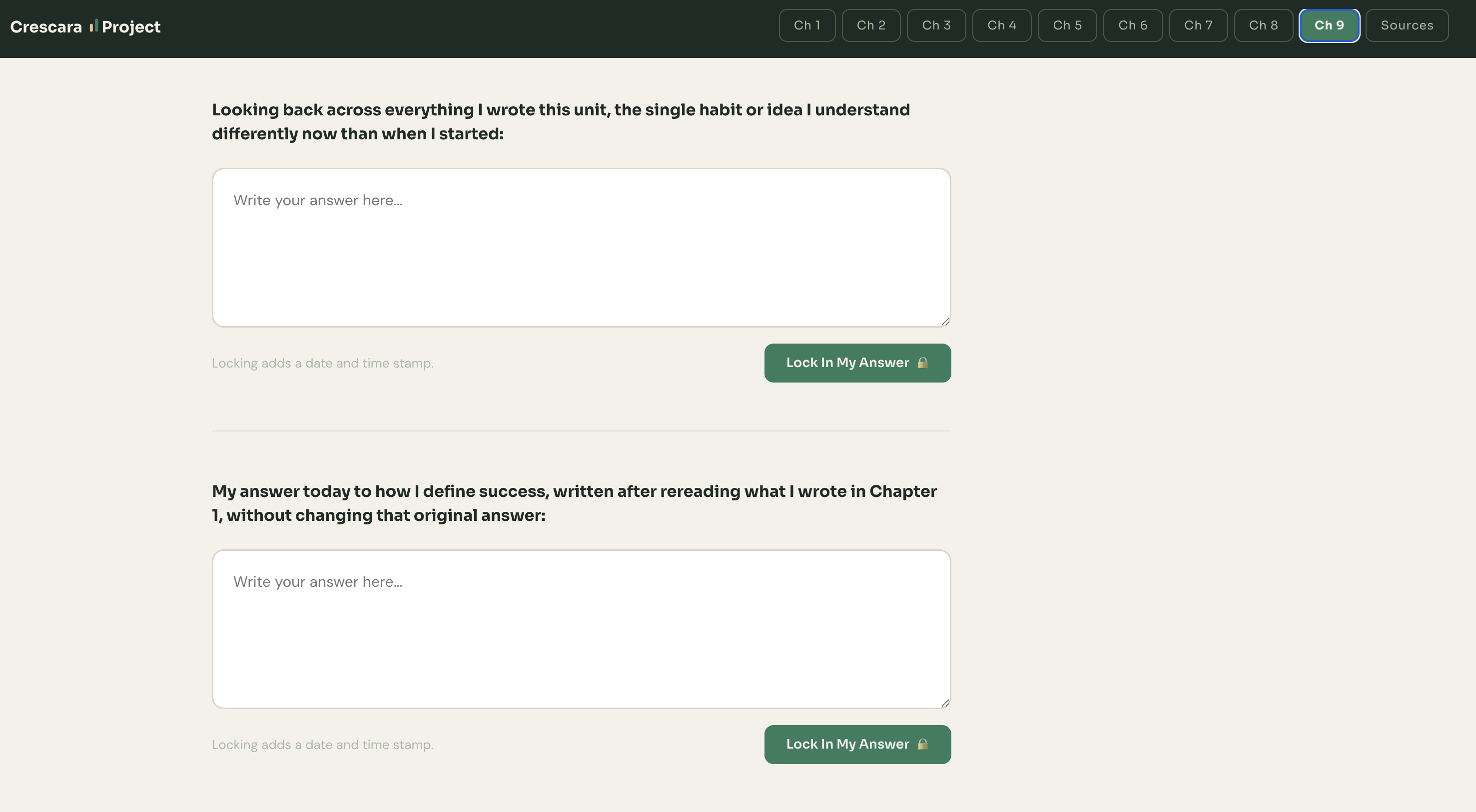
Journal reflection questions with Lock In My Answer button
The Reflection System

Students lock in their answers. Then revisit them.

At the end of every unit, students revisit every reflection they wrote throughout the year. Each answer is timestamped and locked the moment they submit it. They can't go back and change what they said.

Watching how you've changed is part of the education. That shift in thinking is what habit formation actually looks like.

How It Works

Not just content. A system.

Teachable Moments
Every section has a sidebar that translates the lesson into a single, memorable insight. Not a summary. A perspective shift. The kind of thing you remember a decade later.
Journal Prompts, Locked in Time
Students answer reflection questions throughout the year. Each answer is timestamped and locked. At the end of every unit, they revisit them. Watching how you've changed is part of the education.
Three Real Geographies
Every concept plays out through three characters living in three different California cities, each with their own income, costs, and constraints. Students follow the one that matches their real life.
Habits Built In, Not Bolted On
Budgeting, saving every possible dollar, reading fine print , these aren't taught in a single chapter. They're woven through every unit, reinforced through the Consequence Engine, until they're second nature.
The Workbook

Every chapter. Every section. Already written.

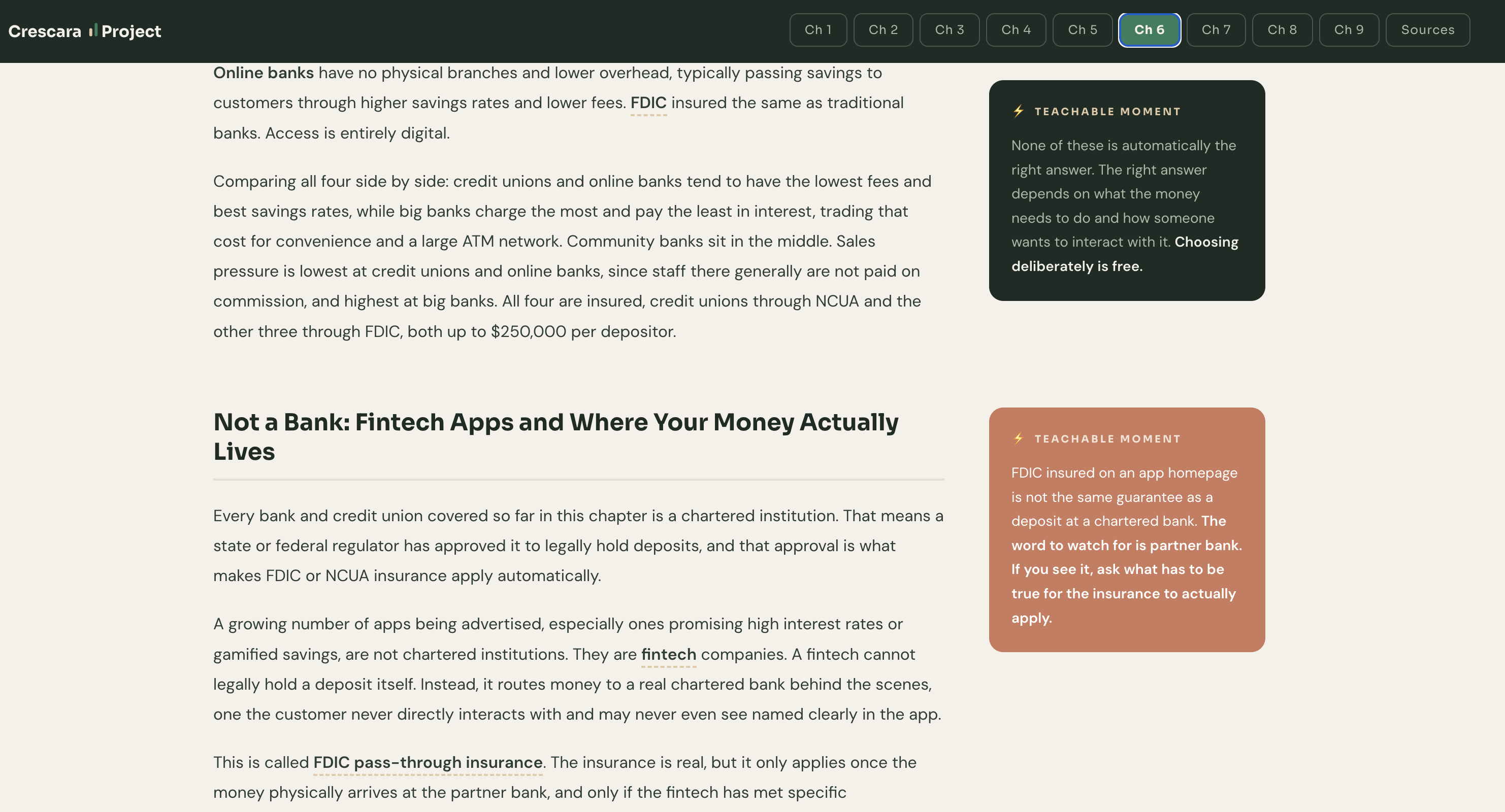
Each chapter opens with a full-screen unit header, moves into dense content with hover-defined vocabulary, and pairs every section with a Teachable Moment , one insight students carry with them after the reading is done.

Activities, reflection prompts, and research exercises are built into every chapter. Nothing is a worksheet. Everything lives in the platform.

Want to see it? Request a demo.
Workbook preview showing Chapter 6 with Teachable Moment sidebar
The Consequence Engine

Students don't just read about decisions. They make them.

The Consequence Engine is an interactive learning dashboard where students manipulate real financial variables and watch the outcomes change in real time. Adjust the budget, skip the emergency fund, take on debt. See what happens.

Five real brokerage platform simulations are built in. Students practice investing decisions in realistic environments before real money is ever involved.

Built to teach the reasoning, not just the vocabulary.
For States That Require Economics

The Economic Literacy Primer and Companion

Six states, Arizona, Arkansas, Idaho, New York, North Carolina, and Virginia, legally require economics content bundled with personal finance instruction, not personal finance alone. The Crescara//Project includes a dedicated Economics companion unit to meet that requirement.

The companion slots in between Unit 1 and Unit 2. Utah's standalone requirement is covered by the first four chapters alone. Every other state's personal finance requirement is fully met by the core three units.

Economics Companion covers
GDP and how economies grow
The Federal Reserve and monetary policy
Market structures and competition
Scarcity, trade-offs, and opportunity cost
International trade and globalization
Required in: Arizona, Arkansas, Idaho, New York, North Carolina, Virginia. Utah's requirement is met by the core curriculum's first four chapters alone.
Expanding the Platform

More is in development.
Funding makes it possible.

The curriculum and the Consequence Engine are complete. Two more tools are in development, awaiting funding to build.

The ARC
A companion tool in development. In development, awaiting funding.
The Marketplace
A contained financial world where students do everything the curriculum teaches , get a job, open a bank account, buy insurance, shop for a car, invest. Every decision has a consequence. They make mistakes here so they don't make them later. In development, awaiting funding.
Ready to bring this to your school?

The Crescara//Project
is ready when you are.

The curriculum is complete. The tools are built. Contact us to learn how to bring it to your classroom or district.

crescaraproject.org · © 2026 The Crescara//Project · Privacy Policy · Press